Image and video hosting by TinyPic Image and video hosting by TinyPic Image and video hosting by TinyPic Image and video hosting by TinyPic
Showing posts with label Pigskins and Pearls 101. Show all posts

Thursday, September 27, 2012

Pigskins & Pearls 101


Today we are resuming a series we started last year, Pigskins & Pearls 101.  While we love gameday fashion and recipes, we also LOVE the game of football.  The holding, the stiff-arms, the blocking, the passing, so we we came up with this series to help explain some of the basic, and not so basic, rules and play calls of our favorite sport. 

 pigskins & pearls

Holding (Offensive) - A foul in which an offensive player keeps a defender from advancing by grasping him with his hands or arms. Offensive linemen are allowed to use their hands as long as they keep them to the inside of a defenders body, but if they get to the outside of the defender's body, it is a penalty


Pass Interference - A penalty that occurs when a player interferes with an eligible receiver's ability to make a fair attempt to catch a forward pass. Pass interference may include tripping, pushing, pulling, or cutting in front of the receiver or pulling on the receiver's arms

Friday, September 23, 2011

Pigskins & Pearls 101: First & Ten

via
That is another FIRST DOWN!  
As the team marches up and down the field, orange sticks march down the sidelines marking the downs and the yards the offensive has gained.

The down markers ("sticks") mark off a ten yard segment.  The offensive team has four tries to get the ball past those ten yards.  That is where the term first and ten comes from.  The team is on their first try to get ten yards.  Hopefully by the second down, the team has less yards to cover.

Typically if the team does not get the ten yards after the third down, they will have to punt the ball on the fourth down.  The coaches have to way the risk to go for on fourth down.  Things to consider are what yard line they are on and how many yards to go.  If they team is in the red zone (20 yards to the end zone), they are likely to kick a field goal to at least come away with some points.


Friday, September 9, 2011

Pigskins & Pearls 101: Kickoff

via
For the initial kickoff at the beginning of each half, the ball is placed on the kicking team's 30-yard line.  Following a touchdown and a field goal, barring no penalties, the ball will be kicked from the 30-yard line, as well.  

Penalties committed by the kicking team following the score will be assessed on the kickoff.  Typically, this will be an unsportsmanlike penalty for excessive celebration.

About half the time, the return-man will field the ball between the 20-yard line and the goal line.  From here, he will rely on his blockers to give him a open field to get yards.  When the ball is kicked into the end zone, the return-man by run it out of the end zone or take a knee.  If he takes a knee, it will be a touchback.  The ball will be brought out to the 20-yard line to begin play.

The on-side kick is utilized at the end of half or the end of the game when a team is trailing by one score or less.  The kicker will muff the kick and direct it to one side of the field in hopes that his team will recover the ball.  The ball must go 10 yards before the kicking team can touch the ball.  Last week, Auburn won their game because they recovered an on-side kick.


Friday, September 2, 2011

Pigskins & Pearls 101: Putting Points on the Board


A touchdown is scored when the football breaks the plane of the goal line either by a rushing or passing play.  A touchdown is worth 6 points.

After a touchdown, the team has the chance for an extra point(s).  They can choose to go for 1 point or 2 points.  For either, the ball will be placed on three-yard line.  Generally, teams will choose to go for one.  The kicker will come on to kick a "field goal." If the team chooses to go for a two-point conversion, it is scored in the same fashion as a touchdown.

A field goal is worth 3 points.  Teams will kick a field goal when it is a fourth down and they are too far to get guarantee a touchdown.  A successful field goal is scored when the ball clears between the uprights or goalposts.  When deciding whether the team will kick a field goal, the kicker's field goal range will be considered.  A field goal distance is usually 17 yards longer than the line of scrimmage to the goal line - that is the ten yards of the end zone and the seven yards between the long snapper and the holder.  If the line of scrimmage is the 30 yard line, the kick will be a 47 yard kick.  This probably the average distance for most college kickers.  Rarely do you see a kicker consistently kicking 50 yarders.

The last scoring opponent is a safety, worth 2 points.  A safety is scored when the defense tackles a player with the ball in their own end zone.

Friday, August 26, 2011

Pigskins & Pearls 101: Defense Formations

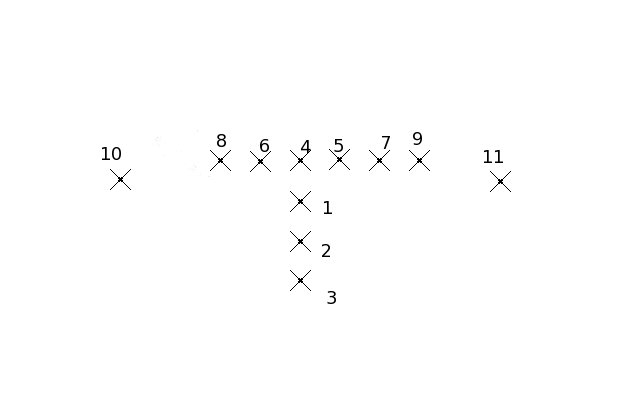
This week's addition of Pigskins & Pearls 101 will be covering the defensive side of the ball.  Defense schemes are more flexible than the offense.  The players are allowed to more around without penalty, unless they encroach into the neutral zone, where they will be flagged for offsides.  There are three main positions on defense - defensive lineman {tackles and ends}, linebackers, and defensive backs {cornerbacks, strong safety, & free safety}.  The secondary, think of it as the second line of defense, is the area where the safeties lineup.

4-3 Defense


1 & 2 - Defensive Tackles (DT)
3 & 4 - Defensive Ends (DE)
5, 6 & & - Linebackers (LB)
8 & 9 - Cornerbacks (CB)
10 - Strong Safety (SS)
11 - Free Safety (FS)

This is a basic defensive scheme.  It is termed the the 4-3, because there are four lineman and three linebackers.  It is easily be switched to a 3-4 defense by having three lineman and four linebackers.  The cornerbacks match up with the wide receivers.  The strong safety is likely to line up on the same side that the tight end lines up.  The free safety is "roaming" defender.  He is used for pass coverage and to top the runs up the middle.

You might hear the term Nickel defense.  It is called this because 5 {five cents} defensive backs are utilized.

When an opponent is heavy on the run game, the defense will look more like the 4-3 or 3-4.  If an opponent is a passing team, the defense may go to a nickel scheme.

Then, there is the blitz.  This is where the linebackers rush the offensive line rather than falling back into coverage.  They may go up the middle or around the end.  It might be a single linebacker blitz or a full blitz.

Remember, defense wins games!

Friday, August 19, 2011

Pigskins & Pearls 101: Offense Formations

For our first football lesson, we are going to start with the two most common offensive formations.  Even these formations have variations depending who is on the field.  There are eleven players on each side of the ball.  I am sure you know the main players - quarterback, running back, and wide receiver.  The players that get all the big accolades and headlines.  But, what about those guys on the line who get those extra yards on the goal line or those few inches when its 4th and inches.

Baisc I Formation


1. Quarterback (QB)
2. Fullback (FB)
3. Tailback (TB)
4. Center (C)
5. Right Guard (RG)
6. Left Guard (LG)
7. Right Tackle (RT)
8. Left Tackle (LT)
9. Tight End (TE)
10/11. Wide Receiver (WR)

In this formation, the quarterback is likely to hand the ball off to one of the running backs.  If he hands off to the tailback, the fullback can become an extra blocker in the backfield {the area behind the line} or out to the side.  The quarterback is directly under the center to receive the ball.  The other members of the line will have specific blocking assignments depending on the play.  The tight end is a blocker and a receiver.  He is the only player on the line that is eligible to receive a pass down field.  He will not always be in on every play, and when he is not, there will most likely be another WR on the play.

Shotgun Formation


1. QB
2. C
3. RG
4. LG
5. RT
6. LT
7. TE
8. FB
9. TB
10/11. WR

The shotgun formation can have two running backs in the backfield or one.  If there is only one, a third WR will be put on the field.  Most pass plays are ran out of the shotgun.  Some plays place as many as five receivers out wide.  This removes the TE from the line and the RBs from the backfield and "replaced" with WRs.  In the shotgun, the quarterback is not under center.  He lines up about five yards behind the center.  This allows for the quarterback more time to get the pass off.  On a pass play, the running back(s) help the line in pass protection.

We hope this helps all the Belles better understand the offensive schemes of your favorite team.